Every major cruise line operating from Florida’s Space Coast wants the same thing: more space at Port Canaveral.
And Captain John Murray, the port’s CEO, has a clear answer for all of them.
“Everybody wants the new terminal,” Murray said, speaking with Cruise Industry News. “And I refer to it as a denominational terminal. It’s not going to be built for any specific cruise line: you’re all going to share it.”
That new facility, Cruise Terminal 4, is targeted for completion in 2029, and Murray said it will be reserved exclusively for large ships, operated on a shared basis, and access will depend on how well a line is already using what it has.
“Until you’re utilizing the one that you have at a much higher level, we’re not giving you more space,” he said.
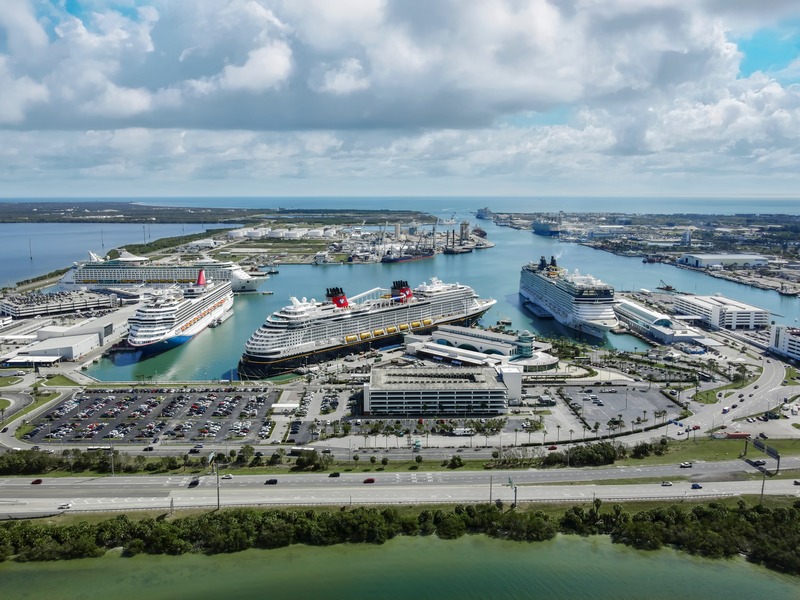
The news comes as Port Canaveral operates at near-maximum capacity across its six terminals, having surpassed Port of Miami in annual passenger throughput last season and making it the busiest cruise port in the world.
The port already operates Cruise Terminal 3, capable of handling the world’s largest vessels, but currently has a 3,500-passenger ship calling there regularly, a situation he described as a poor use of a premium asset.
“It’s not getting the most efficient use out of that terminal,” he said.
Going forward, he intends to correct that.
“We’re going to be a lot more controlling on what ships we have (where), and who gets the days,” he said.
The port has ample experience running multi-operator terminals.
“We do it today, it’s not that hard,” Murray said. “Everybody’s got their own IT network. We’ve run Norwegian, Royal, MSC, Disney and Celebrity out of the same terminal. We’re prepared for just about anybody.”
Demand for berth space at Canaveral is intense and growing.
With all the big brands having large newbuild programs, lines are pressing the port for long-term commitments, and recent discussions are well into the 2030s. Murray noted that when a cruise line is preparing to order a series of new ships, the first question is where those vessels will be deployed.
“When you’re ordering a billion-dollar asset and you’re sitting with your board of directors, wanting to order a series of five ships, the first question is: where is it going to be deployed from?” Murray said. “‘Oh, we’re going to (homeport in) Port Canaveral.’ ‘How long is the agreement?’ ‘We’ve got another six years.’ Well, they don’t want to hear that.”
“It is a different mindset to know where you fit into the equation,” he said. “We are, to some degree, in the power seat. Everybody’s building private islands, and they’re all predicated on short cruising from three ports: Miami, Everglades, and Port Canaveral. They’re all looking for the same thing. But they’re not all going to get what they want.”
The port’s most pressing constraint has nothing to do with cruise ship, It is Route 528, the two-lane highway corridor connecting Port Canaveral to Orlando.
The road was studied for widening more than 20 years ago, with plans to expand it in two segments from Orlando International Airport east to the port.
Those plans stalled, and Florida DOT’s current project timeline now extends to 2045 and 2050, which will be a roadblock for more cruise traffic.
“We can’t last that long,” Murray said. “It’s going to get to a point where it becomes gridlock on the road getting to and from the port from Orlando, and it’s already operating at very high utilization. When there’s an accident anywhere, it backs up for hours.
“The other thing we’re competing with is Space, which has got a lot of expansion in our area,” he said, referencing manufacturing and launch facilities near the port.
Murray’s solution is not simply for the port to lobby offices in Tallahassee. He wants the entire cruise industry to join him.
“I’ve been trying to communicate with all the cruise lines: we need to be collaborative and collectively work with the State of Florida to put the money into this infrastructure, or we’re not going to be able to support the growth of the business,” he said.
“They need to be up in Tallahassee with us, holding hands, saying we need help. They have the power to do that.”
Murray has tied infrastructure resolution directly to terminal development: “We’re not building anything (else) until we figure out the traffic first.”
The new terminal strategy reflects a broader philosophy Murray is putting into practice across the port’s entire terminal network. CT5 is currently undergoing a major expansion, doubling from 90,000 to 170,000 square feet, and the port has strategically shifted some ship calls to Terminal 6 this summer to give construction crews longer uninterrupted work windows.
“We took a year off the completion timeline by doing that,” Murray said. The port is also replacing an existing parking structure with a new $93 million, 3,700-car garage.
Murray said 80 to 85 percent of guests arrive by car.
“When you’re operating big ships, you need approximately 3,500 spaces available for every terminal,” he said. “The choke point we have is that the garage we built at Cruise Terminal 3 is 1,800-plus cars, and as we put larger vessels in there, it’s not going to be big enough.”
On the subject of parking revenue, Murray said Port Canaveral does not share that model.
“We do it for one, we do it for all,” he said. “You all know what each other’s contracts are, so we’re not doing that.”
The port’s growth is reshaping the commercial landscape in the surrounding area.
When Murray joined the port, there were only a few hotels nearby. Today there are eleven, with permits approved for three more, and Murray sees each one as a vote of confidence in the cruise industry’s future.
“They’re betting on the cruise industry,” he said. “Each hotel brings in a quarter of a million dollars in tax revenue, property taxes, to the municipalities. When you get four of them, that’s another million dollars in tax revenue. For a city the size of Cape Canaveral, that’s a lot of income in the municipal budget.”
The economic footprint extends to gas stations, shuttle services and other companies that benefit from the port’s predominantly drive-in guest base.